How an AODD pump works
Compressed air moves two diaphragms joined by a centre rod. No motor, no electricity and no seals on the liquid side.
A positive displacement pump
Liquid enters a sealed chamber. The pump transfers energy to the liquid by moving the chamber walls: expanding the chamber draws liquid in, contracting it forces liquid out. In an AODD pump the moving walls are two diaphragms, driven by compressed air.
- Driven by compressed air: no electrical supply needed.
- Slurries and viscous liquids: handles them; flow depends on viscosity and solids content.
- No electric motor: ATEX versions are available for explosive atmospheres. Whether a pump is an ATEX version depends on its full model code (see the list).
- Self-priming: draws liquid in without external priming.
- Dry running: can run dry for short periods; we do not recommend long dry running at high air pressure.
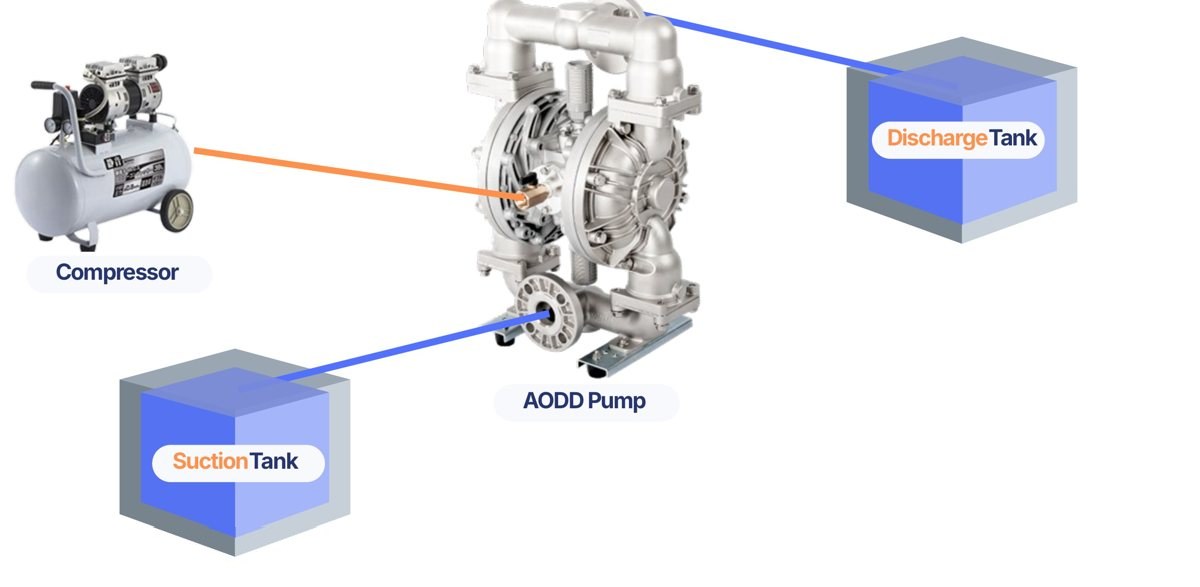
The pumping cycle
- Compressed air enters the pump and moves the centre rod to one side, forcing liquid out of one liquid chamber while liquid is drawn into the other.
- When the centre rod reaches full stroke, the pilot valve switches the air valve (spool) to supply air to the opposite air chamber.
- The centre rod moves back, pushing liquid out of the second chamber and drawing liquid into the first.
- Continuous cycling creates the pumping action. The discharge alternates between the two chambers, which is why AODD flow pulsates.
How AODD pumps work: working principle · Watch on YouTube
YTS uses the Looped C® spool valve for reliable air switching without lubrication. The Air EcoRing reduces air leakage and loss, so the pump uses less air.
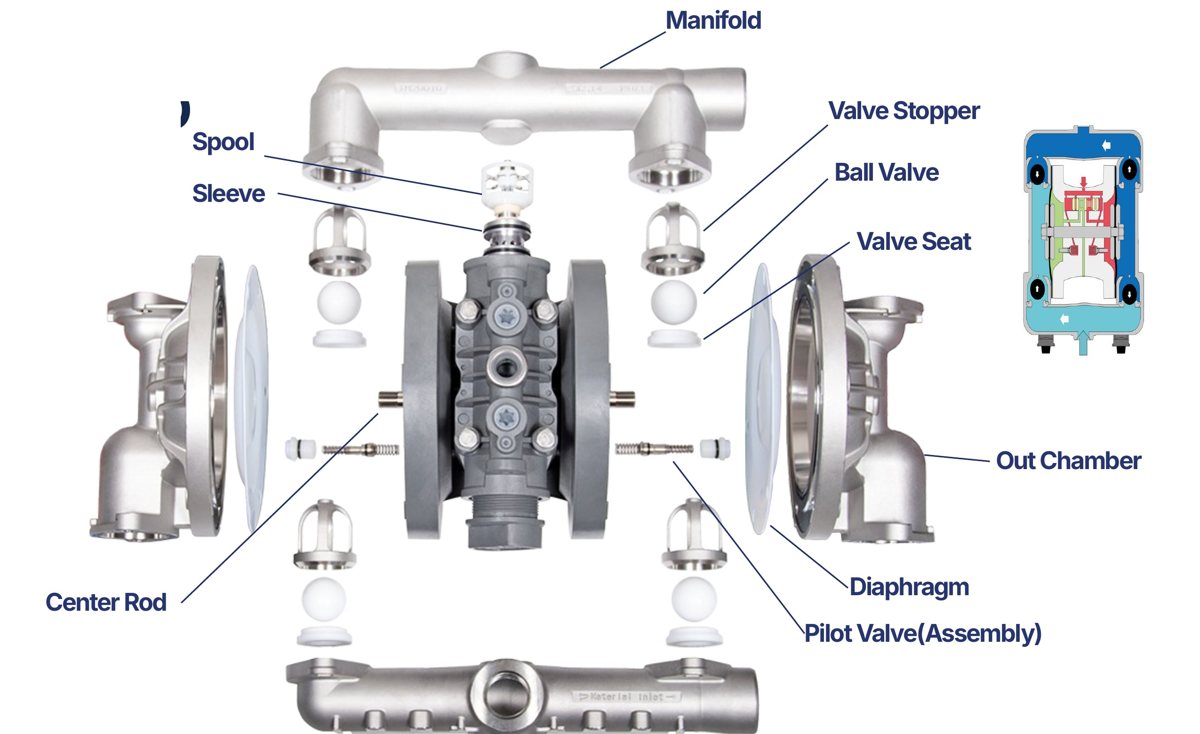
Key components
- Manifolds (suction and discharge)
- Outer chambers (liquid chambers)
- Diaphragms
- Centre rod
- Ball valves and valve seats
- Valve stoppers (guides)
- Spool (air valve) and sleeve
- Pilot valve assembly
Parts lists and service books for every type are on each product page and in Downloads.
What we need to choose a pump
Flow rate
How much liquid needs to be transferred, for example 50 or 100 L/min.
Liquid
Name, concentration, temperature and viscosity. Check materials in the chemical compatibility chart.
Piping
Connection size, and the length, lift height and diameter of the suction and discharge lines.
Air supply
The air pressure available from the compressor.
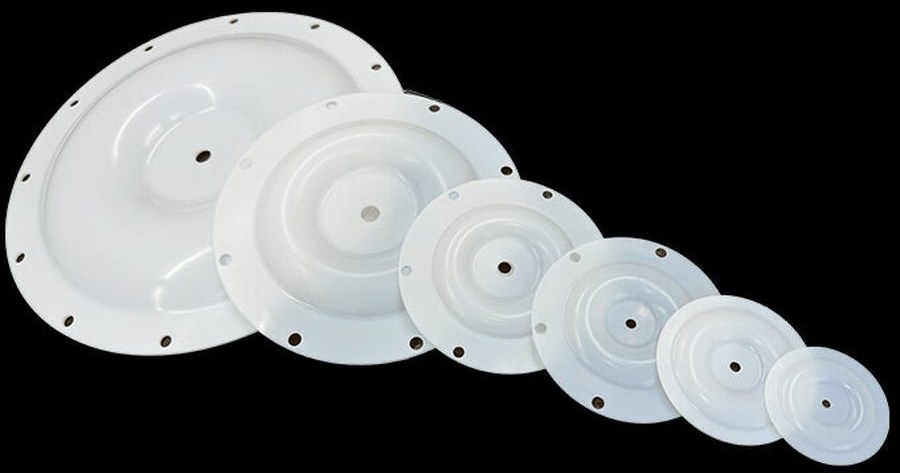
Diaphragm materials
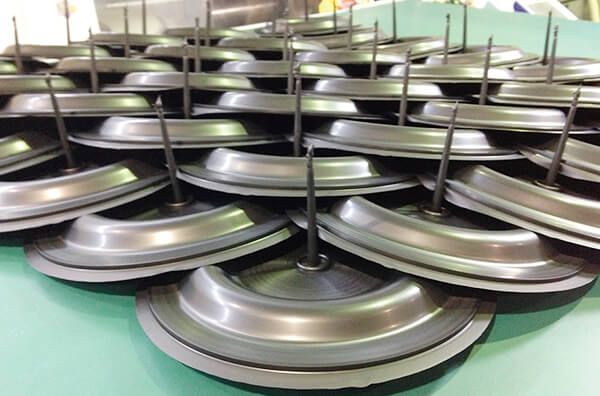
Rubber: flexible
CR (neoprene), NBR (Buna-N), EPDM, FKM (Viton).
Plastics: chemical resistance
PTFE (Teflon), TPEE (Hytrel), TPO (Santoprene).
PTFE with EPDM backing (W)
A PTFE sheet bonded to an EPDM back-up diaphragm in one piece: flexibility and chemical resistance in one part.
Temperature limits by material: AODD pump temperature limits.
Reading a YTS model code
Size
- 050 / 051
- ¼"
- 101
- ⅜"
- 152
- ½"
- 200
- ¾"
- 250
- 1"
- 400
- 1½"
- 500
- 2"
- 800
- 3"
Pump body
- A
- Aluminium
- S
- Stainless steel
- P
- PP
- G
- Glass-filled PP
- V
- PVDF (CFPVDF)
- H
- High-purity PTFE
- F
- Iron
- C
- Carbon-filled PP
- E
- Carbon-filled PTFE
Diaphragm
- C
- CR (neoprene)
- E
- EPDM
- N
- NBR (Buna-N)
- H
- TPEE (Hytrel)
- S
- TPO (Santoprene)
- T
- PTFE
- V
- FKM (Viton)
- W
- PTFE with EPDM backing (one piece)
Connection
- (none)
- PT / Rc / BSPT thread
- N
- NPT thread
- J
- PT air supply, JIS / DIN flange
- A
- NPT air supply, ANSI flange
- F
- Ferrule
- T
- Tube
Suffix
- -M
- Mechanical air motor
- -X
- Non-standard specification
- -MX
- Non-standard version with mechanical air motor
- -EX
- Electric version
- -HB
- PTFE diaphragm with conductive TPEE back-up diaphragm (ATEX version)
Example: D250AT is a 1" pump with an aluminium body and PTFE diaphragms. Not every combination exists for every size; the product page of each type lists the available models.
Tell us the liquid and the flow.
We will reply with a model proposal and price, usually within 5 working days. Operating conditions are optional: add them if you know them.